Ph.D. Candidate  ·  Computer Science

Phaphontee Yamchote

ปพนธีร์ แย้มโชติ  (เต้ย)

Machine Learning Graph Neural Networks Data Science Mathematics

Faculty of ICT, Mahidol University

TEACHING
TO IMPROVE LEANERS
RESEARCHING
TO IMPROVE MYSELF FOR TEACHING

Teaching Mathematics, Computer Science and Programming:
including thier application such as Data Science, Machine Learning, Artificial Intelligence
A dedicated mathematician and computer scientist with extensive experience in machine learning, deep learning, and data science. Specializing in graph neural networks, and I possess strong analytical and problem-solving skills with a proven ability to implement and optimize machine learning algorithms.

Highlight
  1. - Multidisciplinary expert with a strong background in mathematics, computer science, and data science.
  2. - Extensive experience (4 years) in hands-on projects involving data science and machine learning in both manufacturing and financial domains.
  3. - Proficient in designing and implementing machine learning and deep learning models with a theoretical focus.
  4. - Skilled in utilizing PyTorch for deep learning research and development.
  5. - Skilled in algorithm programming and optimization.
ABOUT ME

Education

  1. Ph.D. Computer Science

  2. M.Sc. Mathematics

  3. B.Sc. Mathematics

RESUME

Experience

  1. Lecturer in Computer Science and Engineering

  2. Machine Learning consultant

  3. Data Science and Analytics Mentor

  4. Data and AI Engineer

  5. Intern Researcher

  6. Invited Mathematics and Computer Teacher

  7. Research Assistant and Assistant Data Scientist

  8. Data Analyst

Click Through Rate Prediction on GNNs

Preprint (already presented in conference MLMI 2025, it is in process of public in proceeding)

Click-through rate (CTR) prediction Click-through rate (CTR) predic-tion is essential in online advertising and recommendation systems, affecting user engagement and revenue. Traditional methods like linear models and deep learn-ing often struggle to effectively capture complex, high-order feature interactions. Graph Neural Networks (GNNs) offer improved performance by modeling these intricate relationships but face challenges regarding computational efficiency and interpretability, affecting scalability. We propose a new static graph-based GNN architecture for CTR prediction, incorporating advanced feature selection to en-hance representation and reduce complexity. Our model employs a bilinear inter-action mechanism to efficiently prioritize high-order interactions. Experiments on benchmark datasets show our approach achieves near state-of-the-art results, surpassing traditional deep learning models.

Saw Nay Htet Win Phaphontee Yamchote Thanapon Noraset Chainarong Amornbunchornvej
View Publication

From Features to Graphs: Exploring Graph Structures and Pairwise Interactions via GNNs

Preprint (already submitted, now it is posted on arxiv)

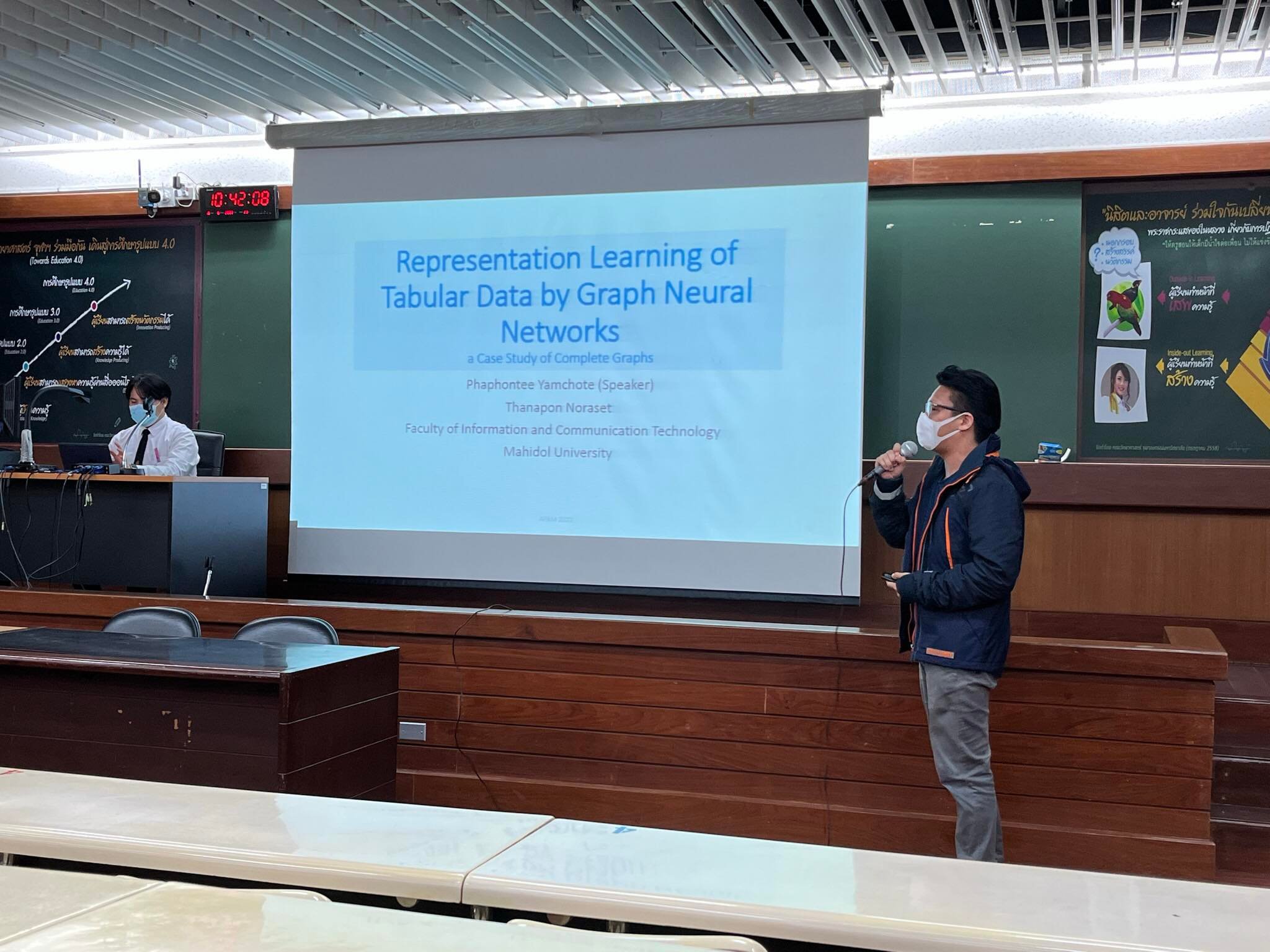
Feature interaction is crucial in predictive machine learning models, as it captures the relationships between features that influence model performance. In this work, we focus on pairwise interactions and investigate their importance in constructing feature graphs for Graph Neural Networks (GNNs). We leverage existing GNN models and tools to explore the relationship between feature graph structures and their effectiveness in modeling interactions. Through experiments on synthesized datasets, we uncover that edges between interacting features are important for enabling GNNs to model feature interactions effectively. We also observe that including non-interaction edges can act as noise, degrading model performance. Furthermore, we provide theoretical support for sparse feature graph selection using the Minimum Description Length (MDL) principle. We prove that feature graphs retaining only necessary interaction edges yield a more efficient and interpretable representation than complete graphs, aligning with Occam's Razor. Our findings offer both theoretical insights and practical guidelines for designing feature graphs that improve the performance and interpretability of GNN models.

Phaphontee Yamchote Saw Nay Htet Win Chainarong Amornbunchornvej Thanapon Noraset
View Publication

Conscious Bias in Thailand Job Posting

Journal: SAU JOURNAL OF SCIENCE & TECHNOLOGY Vol. 10 No. 2 (2024): July - December 2024

This research paper investigates the presence of conscious bias in LinkedIn job postings within Thailand, focusing on gendered language and its impact on recruitment practices. Conscious bias, manifested through explicit preferences in job descriptions, can perpetuate inequality in the labor market. By analyzing job postings across ten in-demand roles in the tech and data-driven sectors, this study identifies patterns of gendered language and explores their implications for gender diversity in recruitment. Using a combination of Natural Language Processing (NLP) tools and statistical analysis, the research reveals that masculine-coded language is more prevalent in technical roles, potentially discouraging female applicants and contributing to the underrepresentation of women in leadership and senior positions. Additionally, the paper highlights the role of educational requirements as a barrier to inclusivity, particularly in fields that favor candidates with advanced degrees. The findings underscore the need for more inclusive job postings and greater enforcement of anti-discrimination policies to promote equality in the Thai labor market.

Phaphontee Yamchote Pemika Cunaviriyasiri Traivith Chupkum
View Publication

Generalized Lojasiewicz Inequality in expansions of the real field

Conference Proceedings: Annual Pure and Applied Mathematics Conference 2020

Let R be an expansion of the real field (R, +, ·). For each f : R n → R, we denote the set of zeroes of f by Z(f) = {x ∈ R n : f (x) = 0}. Let f, g : U → R be functions definable in R (where U ⊆ R n), and p ∈ N. We prove that if A is a compact nonempty subset of U and Z(f) ⊆ Z(g), then there exists θ : R → R such that θ is C p , strictly increasing, surjective, and p-flat at 0 (that is, all derivatives of order at most p vanish); and |θ(g(x))| ≤ |f (x)| for all x ∈ A. In addition, we give an application of this result.

Phaphontee Yamchote Athipat Thamrongthanyalak
View Publication

(Client Training: no pictures due to confidential agreements)

Machine Learning in Azure Machine Learning Studio

Corporate Training

Train interns of DoHome to understand and apply machine learning techniques by using Azure Machine Learning Studio.

Machine Learning Azure ML Studio

Machine Learning for Data Analytics of Cement and Mortar Demand Prediction

Corporate Training

Train corporate staffs of Siam City Cement Public Company Limited (INSEE) to understand and apply machine learning techniques for demand prediction of cement and mortar products via no-code tool in Azure Machine Learning Studio.

Machine Learning Azure ML Studio

Basic Low-Code and No-Code Machine Learning in Azure Machine Learning Studio

Corporate Training

Train corporate staffs of DoHome to understand and apply machine learning techniques by using Azure Machine Learning Studio.

Machine Learning Azure ML Studio

Order Recommendation and Full Truck Load Optimization

Industry Project

Developed a machine learning model for recommendation of orders including item to suggest and amount for particular agents. As well, optimization model for full truck load delivery to maximize the capability of transportation.

Python Machine Learning Azure ML Studio Optimization
Learn More

Web Application for Submitting Machine Learning Jobs

Industry Project

Developed a user-friendly Streamlit-based application integrated with Celery for job management.

Python Streamlit Celery
Learn More

Data Platform: PySpark data engineering on Microsoft Fabric

Industry Project

Develop ETL process migrated from on premise database of Retail chain of a petroleum and energy business in Microsoft Fabric

Python PySpark Microsoft Fabric SQL Power BI
Learn More

Stepwise Interest Rate Portfolio Optimization

My Project

This project is motivated by a post from facebook page here. Designed a portfolio optimization model to maximize annual interest profits through stepwise rates.

Python Pyomo Streamlit
Details

Weak Supervision from Multi-stage HDD Break-down Prediction

Industry Project

Investigate the potentiality of applying weak supervision techniques to improve prediction accuracy in uncertainty scenarios for manufacturing data of Western Digital.

Machine Learning Python Data Science
Learn More

Automated Rounding for Financial Balance Sheets in Audit Process

Business Solution

Implemented Python optimization algorithms to reduce routine audit report processing time from 5-10 minutes per job to 1-2 seconds.

Python Optimization Integer Linear Programming
Learn More
Portfolio

What I have ever done

Data Analyst

in audit

Innovative Developper

in audit

Data Scientist

in manufacturing industry

Machine Learning Researcher

in manufacturing industry / for data science

Programming Language
  • Python (Expert):

    data science, machine learning and deep learning, mathematics and statistics

  • Java (upper-intermediate):

    teaching of data structures and algorithm

  • C (intermediate):

    operating system, competitive programming

  • C++ (pre-intermediate):

    competitive programming

  • MATLAB (pre-intermediate):

    zmathematics, machine learning, signal processing

  • JavaScript (pre-intermediate):

    artificial intelligence, web application

  • SQL (pre-intermediate):

    data management, web application

  • R (beginner):

    statistical analysis, machine learning

  • Haskel (beginner):

    functional programming teaching

  • Programming Language Theory:

    Make me can learn any programming language faster

Softwares
  • Machine Learning

    Scikit learn

  • Deep Learning

    Pytorch, TensorFlow and Keras, Apache Mxnet, Pytorch Lightning

  • Graph Neural Network

    Pytorch Geometric

  • Natural Language Processing

    SpaCy, LangChain

  • Container environment

    Docker

  • Web Application Development

    Google Apps Script, Python Django

  • Data Analytics

    Pandas, Apache Hadoop, Power BI, Excel ElasticSearch

  • Database Management

    MySQL, MS Access

  • Low-code/No-code framework

    Orange (machine learning), Scratch (programming for kids)

  • Optimization

    Pyomo

  • Development

    Vscode, Linux

WHAT I CAN DO

Get in Touch

The best way to contact me is Email:

yamchote_p@outlook.com

Telephone:

+66870492475
Contact